Fringe - "Johari Window" (2.11)

This episode is much better than Monday's episode, and that could be because it gets us back into the second season swing of things. I also really like the story, and the acting is good, too. That is not to say, of course, that the acting that we see in “Unearthed” (1.21) is not good, but I like the story of “Johari Window” much better. The science behind the episode is explained with a bit more precision, and although I am not sure how accurate it is, I think that it is a really neat idea. However, the point of this entry is not to compare the two episodes. I just figured that since there were two episodes that aired this past week, I would briefly discuss which episode I prefer over the other. As usual, I warn you that if you haven't seen this episode yet or have not even watched Fringe at all but would like to watch it at some point in the future, then please don't read any further, as this entry will contain spoilers that pertain both to this episode and to the series in general.
 
This episode tells the story of a small town in upstate New York called Edina (I actually did some research to find out whether or not this city is real, and not surprisingly, it is not), in which a small but entire population of disfigured people who appear “normal” has, for years, been taking extreme measures to keep its abnormality a secret, extreme measures that include murder. The team learns that the people of Edina appear “normal” even though they are disfigured because of an electromagnetic pulse that manipulates vision, causing people to see objects differently than they actually appear. For example, Walter sees a butterfly, which is actually a moth, because of the pulse. As I said, I am unsure of the validity behind this kind of “science,” but even if it is not possible, it is a really interesting idea, and perhaps, it is something that will be possible one day soon if it isn't already.
 
What I don't understand about the first scene of the episode is why the cop suddenly sees the boy in his real, disfigured appearance after just having seen him appearing “normal” moments before. I understand that the pulse causes people to see the people of Edina as “normal” people, but what exactly causes the change? What made the butterfly alternate between being a moth and being a beautiful butterfly? Is distance involved? Perhaps, once you travel a certain distance from the pulse, it stops having an effect, which is why the young boy seems to suddenly change in the cop's car. This would also explain why the moth once again becomes the butterfly; Walter and Astrid get close enough to Edina for the pulse to start taking effect. However, how exactly does the pulse work? How does it determine what people will see? For example, how does it determine that the moth will be seen as a butterfly?
 
I find it interesting how, during the first season, Peter was easily annoyed when it came to Walter. He would become frustrated, and he would spew off vehement sarcasm in response to Walter's wildly scientific explanations. Now, however, Peter is not annoyed but instead seems to think that he's funny. He also seems to be a lot more patient with Walter. For example, during the scene that takes place at the lab, Peter calmly explains to Walter that he understands that the moth and the people seem to be transforming but that “I just don't see how that's possible.” Last season, I think that he would have said something more along the lines of “You are out of your mind!” It's nice to see their relationship developing to such lengths, but as I have said before, it is also heartbreaking, because it's becoming more and more obvious that it's not going to be too much longer before Peter learns the truth about his past, and time will only tell how he is going to react. The final scene is especially heartbreaking; Peter tells Walter that he is proud of him for standing up for the people of Edina, and Walter says, “I'm glad you choose to see me the way you do, very glad.”
 
Numbers play a somewhat important role in this episode. Firstly, after paying close attention to Edina's Census records, Peter points out that since a particular year in the past (I don't recall the precise year, but I believe that it is during the early 90s, such as 1991 or such), seventeen people died, and forty-seven people were born, information that he later uses to conclude that the entire population of Edina is disfigured, since no one has moved into the town, and no one has moved out of the town, and of course, this is where the frequent use of the number forty-seven is placed. Additionally, Olivia remembers that the town's total population, according to the Edina sign that they see when entering the city, is 1,943. This reminded me of episode 1.10, “Safe,” when Olivia tells Peter that for as long as she can remember, she has been very good at remembering numbers, and as I am sure that I have pointed out before, I wonder if this is a result of her Cortexiphan trials. We do know that Olivia is incredibly observant and that that is most likely a result of her Cortexiphan trials, so it is not far-fetched to assume that her ability to remember numbers is, too, especially since such an ability is technically an example of an observation skill. She observes details to which most people probably wouldn't pay much attention, including, if not especially, numbers. I found this to be worth mentioning, anyway.
 
Before I discuss the title of the episode, I should disclaim any credit that would most likely otherwise be understood as my own, for I am not the one who initially did the research; the credit goes to David Wu of the Fringemunks, who first did the research and then shared what he discovered both on his Facebook profile and on the latest episode of The Fringe Podcast, which he co-hosted. He retrieved the information from Wikipedia, so I am merely going to quote the Wikipedia article. “A Johari window is a cognitive psychological tool created by Joseph Luft and Harry Ingham in 1955 in the United States, used to help people better understand their interpersonal communication and relationships.” Basically, the “window” helps people better understand themselves in regards to what they know about themselves, what they don't know about themselves, what other people know about them and what other people don't know about them. In an effort to help explain, pictured below is the “window” provided by Wikipedia.
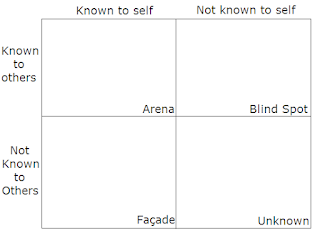
The title of the episode fits well with the theme of the episode. For example, the people of Edina were the same people regardless of how others saw them (literally and figuratively), and this entire episode is based heavily on perception. Returning to the final scene of the episode, Walter tells Peter that he is glad that Peter chooses to see him in such light, and the key word here is “choose.” Bravery could very well be a blind spot for Walter, because Walter may not see himself as brave, which could be why he uses the word “choose.” Additionally, Peter does not know that he was abducted from the other side, but Walter does, and this therefore serves as a blind spot for Peter. It also serves as a façade on Walter's part, because he knows that he abducted Peter from the other side, but no one else knows this. I find it interesting how one can make these connections based merely on the title of the episode. For those of you who are not aware, the episode was originally titled “Edina City Limits,” and not too long before it was aired, the episode title was changed to “Johari Window.” The original title would have worked, as well, since the people of Edina are confined to the limits of their city, but I think that this title is a lot more interesting.

I did not catch this when I watched the episode, but according to Fringepedia, the colors red and green are featured in the episode. Quoted directly from Fringepedia, “A red and a green tractor are outside the barn when Peter and Olivia are running from the Sheriff and his Deputy.” What I did catch, however, is that the
Wizard of Oz references that have been provided throughout this season has finally been completed. In “Night of Desirable Objects” (2.02), the scarecrow that stood on Andre Hughes' farmland serves as a motif throughout the episode, and in the following episode, “Fracture” (2.03), the project that causes people's bodies to crystallize is referred to as Project: Tinman. Now, in this episode, Walter refers to the Cowardly Lion when he expresses his fear of again being kidnapped by Newton. We have not yet seen or heard of a direct reference to Dorothy, but perhaps, Olivia having traveled to another world and then returning home was the intended reference to Dorothy. The question is whether or not these obviously intentional references are going to mean something in the end; I mean, there has to be a reason why they are being presented.

Anyway, I think that that is about all that I have for this episode. Overall, it was a decent episode. As David Wu stated in the latest episode of
The Fringe Podcast, this season, the “stand-alone” episodes have been “hit and miss,” and this one is definitely a hit (as opposed to “Night of Desirable Objects” and “Snakehead” which, in my opinion, are both misses). Overall, I give the episode seven and a half Operation games, which seems somewhat low, I know, but it's only because it's a “stand-alone” episodes. It's very rare, if ever, that I will give a “stand-alone” episode anything above a seven, so a seven is very good. Next on Fringe is “What Lies Below” (2.12). It would appear, based on the promo clip, as if an ancient virus surfaces and infects Peter, who is therefore quarantined, so it ought to be interesting. It's not always easy to determine whether or not an episode is going to be “stand-alone” or not, because sometimes, a seemingly “stand-alone” story later relates to the Fringe mythology somehow, as are the cases with “'Fracture” (2.03) and “Of Human Action” (2.07). Anyway, in the meantime, stay on the fringe.

Fringe - "Unearthed" (1.21)


Fringepedia has this episode numbered as 2.11, but I refuse to do it that way because this is not truly a season 2 episode. As I'm sure those of you reading this already know, this episode was filmed during and for the season 1 run but was later cut due to a time constraint. Thanks to American Idol, it was simply necessary to cut an episode, and I'd say that the right choice was made, since this episode is completely and entirely "stand-alone," having nothing whatsoever to do with the overall scheme of the series. It honestly annoys me that it appears to be being given a “2.11” production number, because the episode confused a great deal of people. A lot of people could not understand how and why Charlie was still alive, which is something that I expected to happen. FOX failed to advertise the episode as an episode lost in the shuffle of the first season and instead merely recognized it as being aired on a special night, so people who are not Fringe fanatics and therefore don't bother to look into details were confused. However, this is all material that I will dig into throughout this entry. I give this episode five possessed Lacey Mosley lookalikes, and, as usual, please be advised that if you don't wish to be spoiled with details pertaining to this series (which, if you don't, I apologize for those that I have already given), then please do not read any further.

As I said, this episode has nothing to do with the mythology of the show and is probably the biggest prototype of the “stand-alone” format that the series has seen so far. That automatically lowers the score, but even then, the series has seen some decent “stand-alone” episodes, such as episode 2.05, “Dream Logic.” This one is decent, and the acting is exceptional (especially that of Alice Kremelberg, who plays the role of Lisa Donovan), but I am not happy with the fact that there is absolutely nothing to connect it to the overall scheme of the series, as I've already said. With the exception of the discovery that Olivia is apparently not a “religious woman,” we don't even get a lot of character development. The primary purpose of this episode seems to be to bring religion into the ring, but as I said at the beginning of the second season, I really don't think that that is necessary. The X-Files is very heavily focused on the battle between fact and faith, and I really don't want to see Fringe venture in that direction, too, and I am not, by the way, attempting to draw comparisons between the two series. In fact, I am merely hoping that action is taken (or not taken, for that matter) to avoid having the comparisons be drawn any further. Fringe is an incredible show that is much better when it sticks to its own ideas.

There are a few observations that I've made about the episode in general, and for starters, I find it interesting how the episode's intro is the season 1 intro, yet it's still being given a season 2 production number. Also, during the season 1 run, episodes were of extended length due to shortened commercial breaks, but this episode was of normal length like episodes during the season 2 run. The only answer to the latter question that comes to my mind is that a few scenes were cut in order to fit the episode into the allotted time. I also really find it interesting how the theory that this episode isn't even an episode cut from season 1 but is instead an event from an alternate reality quite interesting but not because it has any validity to it; I, in fact, find it so interesting precisely because it does not. Quite a while ago, we were told that Fringe would only be dealing with two realities, so the theory that this episode takes place in the alternate reality is not possible, or else Peter would not exist. Additionally, there is proof that this episode is an episode which was cut from season 1, proof which I provided so long ago; I provided a link to a promo video for season 2, aired at the end of season 1, that shows clips from this episode (http://www.youtube.com/watch?v=FQ_WbL49OqE). The only way that clips would have been available that early is if the episode had already been filmed.

That promo was one clue that led me to believe that we were missing at least one episode from season 1, one of three clues. The second clue is that just before the series returned from its spring break last year, promos first advertised the return as an initiation of the final seven episodes of the series, and we ended up only seeing six (“Inner Child,” “Unleashed,” “Bad Dreams,” “Midnight,” “The Road Not Taken” and “There's More than One of Everything”). I'm not quite sure where “Unearthed” falls into the lineup. Initially, I figured that it takes place between episodes 1.18 (“Midnight”) and 1.19 (“The Road Not Taken”), but that's what brings me to the third clue. In “Midnight,” Rachel is on the phone with Olivia, crying because her ex-husband wants custody of Ella, and that is an issue that has yet to be resolved. I assumed that, since at the end of the season finale, we see Olivia sitting on a bed with what appears to be a packed suitcase, the missing episode dealt with what ended up happening to Rachel as far as that issue is concerned, but, as you know, Rachel is not even in this episode, so I guess that I was wrong about that. It's just frustrating because I don't understand the purpose of that scene in “Midnight,” and I won't understand the purpose of it until some closure is provided.

All right, well, this episode centers itself on seventeen-year old Lisa Donovan, who after experiencing an aneurysm and going brain dead, suddenly wakes up and spews off a Russian code after being pronounced dead just after five in the morning. Lisa's mother is a closed-minded Christian woman who simply wants to put all of this behind her and Lisa, but Lisa keeps seeing a man named Andrew Rusk, who is closely linked to the Russian code that she shouts out when she awakens. Olivia and the rest of the team want to help her, but Lisa's mother refuses, not wanting to subject her daughter to any scientific experiments. She feels that the explanations that the Fringe team are offering are ridiculous and are outside the realm of possibility. At one point, she asks Olivia if she is “a religious woman,” and when Olivia replies that she is not, Lisa's mother tells Olivia that she therefore probably casts judgment on those who use faith to help guide them through decisions that need to be made for their loved ones. It ends up being discovered that the moment at which Lisa was “resurrected” was the moment at which Rusk was murdered, and the diverted energy was moved to Lisa, causing her to share consciousnesses with him, which is why she is seeing him (a similar idea to one we see earlier in the season, when Olivia keeps seeing John Scott due to his consciousness sharing her mind with her own). Rusk's consciousness did not pass with his body because right before he was murdered, his murderer told him that it was Rusk's wife that arranged his murder, so Rusk wants revenge.

It was nice although also odd seeing Charlie in this episode after not having seen him in such a long time. Additionally, Peter's attitude toward Walter is a lot more like attitude toward him in season 1, which is also odd to see. Walter suggests that perhaps Lisa's spirit floated over Andrew's when she died, and Peter's typically dismissive sarcasm then comes into play, something that we haven't seen much this season. He says to Olivia, “You tell me the U.S. government is covering something up, I'll tell you it must be Tuesday,” which I find funny because the series aired on Tuesdays last season. Then, of course, there is Astrid's hair, which is long like it was last season. Needless to say, the episode is most definitely an episode that was cut from season 1. Something that I do find worth mentioning, however, is that according to Fringepedia, “Lisa Donovan's FBI file states her birth as 19 November 1982, placing the majority of this episode in late 1999 or early 2000 – is this evidence of the alternate universe?” Needless to say, this really complicates matters a great deal, and it's frustrating, although that was most likely just a production error.

There are a number of unanswered questions in this episode, but they are not questions pertaining to the overall mythology of the series. Instead, they were questions pertaining to this stand-alone story. For example, did Tusk's wife really have him killed, or was this a fabricated story made up on the Navy's part to cover something up? Additionally, how is Rusk's consciousness jumping bodies? Does it select random people, or is there a specific reason as to why Lisa shared his consciousness? What about the man at the end of the episode? Is he important at all? If Tusk's wife did have him killed, then is he going to try to kill her again? Is that why, even at the end of the episode, his consciousness still has not crossed over with his body? Speaking of the end of the episode, I find that scene to be really creepy. The man appears to be dead as a result of the crash, bloodied up, and directly after the paramedics declare that he has no pulse, he awakens, much like Lisa does at the beginning of the episode, and he says something in Russian in a rather dark and sinister voice. I just find that ending to be really creepy and disturbing, even. Overall, I think that this episode is very disappointing, and season 1 does not need it at all. I would have rather it have been placed on the season 1 DVD set instead of awkwardly aired halfway through the season 2 run, confusing people.

Fringe - "Grey Matters" (2.10)


Grey Matters” is a major step-up from the previous episode, “Snakehead,” and I give it eight and a half chicken wings. If nothing else, this episode certainly does give us a lot to think about during this lengthy holiday hiatus. Speaking of the hiatus, I have heard both good news and bad news from the Fringe Podcast. The bad news is that Fringe will not be returning January 7th like it was supposed to return. Instead, it will be returning one week later on January 14th (even though there will be a surprise on January 11th, which I will discuss later). As you probably already know, this season is scheduled to contain twenty-two episodes, and at this point, the schedule was set up perfectly in order to fit those twenty-two episodes. With this week-long delay, it will not be possible to fit all twenty-two episodes into the season. That sounds like bad news, but this is where the good news comes into play. The season finale will air on Thursday, May 13 and will be two hours long, and a two-hour finale is definitely good news to me. Anyway, as I always advise, do not read any further if you have never seen Fringe but would like to, since it will contain spoilers.

The opening scene of this episode is so great. Slater seems almost as if he is hypnotized, and despite the fact that the back of his head is completely open, he remains very calm, and this is really what makes the scene so disturbing. When the nurse comes to the door and sees him in the state in which he is, all he does is calmly say, “Help me.” I do kind of like Newton, since he kind of reminds me of Jones. Don't get me wrong, however; I still really miss Jones, and Newton will not be replacing him any time soon. Hopefully, this season doesn't do the same as the first season did and kill Newton off at the end. I am still hopeful for the day that Jones will return via alter-Jones, and hopefully that is something that will happen eventually, because Jones was such a cool villain, and it's disappointing that he was killed off so quickly with so many questions unanswered.

The scene in which Dr. West is explaining Slater's background to Olivia annoys me because a good deal of it is nothing more than exposition. She tells Olivia that Slater has been a patient for fourteen years and that he has been diagnosed with Acute Paranoid Schizophrenia. Olivia then says, “His file says that he suffered from delusions, false memories and severe emotional swings,” which West confirms. Those are basically the symptoms of Acute Paranoid Schizophrenia, and Olivia probably knows that. It seems like she should, anyway. However, it's quite obvious that the line was dropped into the script so that viewers would know exactly what it is, just in case there was anyone who didn't, which I'm sure there was. It was helpful but hokey, and I hated it.

Something odd that I would like to point out is Walter's apparent lack of nerves in the mental institution in this episode. In episode 2.05, “Dream Logic,” he is so bothered by being in the hospital in Seattle, which isn't even a mental institution. In this episode, though, he isn't anywhere near as disturbed as he is in “Dream Logic,” and this
is a mental institution. I'm not going to say that he is not shaken up at all because it is quite obvious that, as it reminds him of his time at St. Claire's, it does. This is especially obvious during the scene in which he insists on seeing Slater when he was insane, and they therefore review a videotape. You can tell from the look on his face that it crushes him as he wonders whether or not he was ever that bad or possibly knows of a time in which he was and is being reminded of it. Walter is definitely a character for which to feel a great deal of sympathy in this episode.

During the scene in which Peter and Olivia are talking to Deborah Crampton, I thought for sure that when she said that it was only one number with which she was obsessed, she was going to say “47.” I was actually very surprised when she said that the number with which she was obsessed is 28, because that would have been a perfect time to throw it in, but perhaps they felt as if that would have been
tooblunt. Anyway, I love how during the scene in which Walter is explaining how he had once tried to convert brain tissue from one organism to another but failed to do so, he just happens to have a brain lying around his lab. Of course, I really wouldn't put that past him. When he and Peter got his car in episode 1.02, “The Same Old Story,” they found a hand in a glass jar, so it's probably not that far-fetched when it's Walter who is the topic of discussion.

So, from the ending of the episode, we know that William Bell is Dr. Paris, but this just leads to more questions, which is so typical of J.J. Did he have anything to do with Walter being questioned in the comic book series? In the sixth and final comic book, Walter is repeatedly visited by someone while he is at St. Claire's. That someone is trying to extract information from him regarding the time at which Walter and Peter were saved by September. Most likely, he was trying to extract information from him regarding the night that Peter died and Walter therefore opened a door between universes and “kidnapped” alter-Peter, which is what Newton does in this episode, but did Bell have anything to do with Walter being questioned during his time at St. Claire's? Is Bell a good guy, a bad guy, or is it merely a matter of perspective? If he put Walter's brain tissue somewhere where only he would find it, as he told Walter, then how did Newton find it?

The scene between Walter and Peter when Walter is about to have an MRI done is very touching. The two of them are getting so close, and as I keep saying, as touching as that is, it also very heartbreaking because sooner rather than later, Peter is going to find out about his past, and I have no idea whatsoever how he is going to react to that. He is obviously going to be incredibly angry, and that will be his reaction, but what I mean to say is that I have no idea what action he will take. Will he simply be angry for a few weeks or possibly even months and then eventually learn to forgive Walter, knowing that he only did it because he couldn't stand his son not being with him and alive, or will he want to quit the team? I have read some talk that even goes as far as to suggest that he will in fact switch sides and start fighting for the bad guys, but I am not inclined to agree with this; I think that that's a bit ridiculous. His sense of right and wrong wouldn't logically change because of that. Anyway, Peter feels very guilty for never having visited him while he was at St. Claire's, and as I said, this is both touching and heartbreaking to see.

As for Walter's abduction, I knew that the tracking chip that he implanted at the end of the previous episode, “Snakehead,” would come into play in this episode, most especially when I saw the preview for this episode. It seemed like an easy way out, however, which is why I was not surprised when Peter and Olivia discover that the chip had been taken out. I feel so sorry for Walter, as I often do during this episode, when he is shown the photograph of the coffin and therefore begins crying, since he is reminded of Peter's death. I also have to wonder if the “girl in the red dress” being named Sydney is a shout-out to
Alias. I am absolutely certain that it is, but I am unsure of whether or not it was referring to the same Sydney. I cannot recall where Sydney was born or where she was raised. For a good part of her childhood, she was raised by Arvin and Emily Sloane, but I can't recall if that was in Cambridge or not. If so, then this is an obvious tie-in, but I think that it is a shout-out either way.

As for Walter's memory loss, Darrell from the
Fringe Podcast was, more or less, right. During the first season of the show, he proposed that perhaps Walter's obsessions with food are his mind's way of “trying to recreate a moment in time to help him remember,” as Peter puts it, and he was right about that. A good example comes right from this episode, when he wakes up from having been poisoned by the neurotoxin and says that he has a sudden craving for chicken wings. Speaking of this scene, Peter was definitely about to cry when he was pleading for him to wake up, saying, “Walter, can you hear me?” You know, it would definitely be a twist if by the time Peter finds out about what Walter did, he will have been too close to him to really hold too much against him. I mean, he really is at the point where he cares deeply for him. During the scene in which Olivia tells Newton to go to hell, I thought for sure that she was going to shoot him, but, obviously, since she doesn't, it didn't last long, but that definitely would have been disastrous. Once again a very cool villain would have been dismissed, and Walter would have been dead.

I have previously touched upon the ending of the episode rather briefly, but I have to wonder whether it is a flashback or a memory that we see. Is that information being given solely to us, or does Walter suddenly remember that? I have, of course, already discussed William Bell's intentions, which are immensely unclear, and sadly, they may never
be clear, because Nimoy signed for three episodes, and this was his third episode, so it's possible that we may never even see Bell again unless it is in a flashback with a younger actor portraying him, which I suppose could still be effective. Anyway, I have good news for my fellow fringies, very good news, in fact. Fringe will not be returning on January 14th but instead January 11th with the previously unaired episode “Unearthed.” The episode is an episode that was cut from the first season and is intended to give Fringe a boost in preparation for its upcoming spring hiatus. Most likely, it is this episode here,http://www.youtube.com/watch?v=FQ_WbL49OqE, since this is all footage that we have not seen, and most likely, it takes place between episodes 1.18 and 1.19, since we never heard anything more regarding Rachel's battle for custody of Ella. Also, the initial promo advertising the show's return from the spring hiatus said that the return would initiate the final seven episodes of the season, and we only had six. I am really looking forward to this, and then, three days later, on January 14th, the second season returns with episode 2.11, "Edina City Limits." Until then, stay on the fringe.

Fringe - "Snakehead" (2.09)


I honestly think that I may have enjoyed “Night of Desirable Objects” more than I enjoyed this one. Hands down, this episode is one of the absolute worst episodes of the series thus far. It doesn't get any more than 5 assaulted Astrids from me, and the only reason why it even gets that is that there is some character development between Walter and Astrid in this episode, and I think that that ultimately does help move the story along but in this case, only just a tad bit. I watched an interview today with Josh Jackson in which he reveals that the story involving Walter's betrayal will most likely not be revealed until near the end of the season (and he mentions Olivia's betrayal, as well, which totally stumped me, because I don't understand how Olivia betrayed Peter), but the point is that they seem to be taking the easy way out. If their plan is to span the story out to the end of the season, then having so many “stand-alone” episodes such as “Night of Desirable Objects,” “Dream Logic,” “Earthling” and “Snakehead” make that relatively easy to do, especially when a majority of the episode doesn't do much for the overall agenda. Anyway, this is all material that this entry will cover, but if you have never seen Fringe but would like to see it, then, please don't read any further, since this entry will contain spoilers.

In episode 2.02, “Night of Desirable Objects,” there is at least the back-story involving Olivia's return to this reality. This episode, however, bears only the aforementioned development between Walter and Astrid. Jasika Nicole said in her interview with
The Fringe Podcast that in an upcoming episode, there would indeed be development between the two of them, and I definitely think that it is safe to assume that this is the episode to which she was referring. Like I said, apart from their development, this episode doesn't really have much to offer. I do like seeing Walter coming out of his shell, striving for independence and for the ability to make up time that he lost during the seventeen years that he was in St. Claire's. I have been saying for quite some time now that it is interesting to see how Walter and Peter often switch roles, whereas Walter becomes the child, and Peter becomes the father, and obviously, Walter is well aware of this. Usually, even the “stand-alone” episodes have really good endings, and this one really doesn't. I do think that it is very cool of Walter to implant a tracking chip in his neck so that Peter and Olivia know where he is, and I see that as Walter's way of trying to show Peter that he can be trusted. Most likely, this chip will come in handy in the next episode, but I won't say any more than that.

That last scene is incredibly heartbreaking to watch, though, because Walter says to Peter, “I've been out of the institution for a year now, and I've just begun my journey back towards being whole.” I think that a very major part of what Walter is talking about here is the fact that he is finally getting Peter back in his life. Peter is finally beginning to warm up to Walter, and their relationship is escalating to places that it has never been before. However, soon enough, Peter is going to discover the truth, and when that happens, only time will tell how angry he is going to be. I would imagine that there will be a sudden split in their relationship. If I lived in
Fringe's world, I honestly could not possibly imagine how I'd feel if my father told me that he kidnapped me from an alternate reality and has been lying to me ever since, not only about that but also (most likely) about my mother being dead. I think that my primary sense of betrayal would come from the fact that I'd feel completely out of place, like I wouldn't belong. Seeing Peter learn the truth is something that is going to be very difficult to watch.

I do have to give this episode credit for having such a massive gross-out factor. I don't think that
Fringe has ever made me want to throw up like this episode does. One of the first lines in this episode between Olivia and Peter really does help sum it up. Olivia asks Peter when he arrives at the scene whether or not he has eaten, and when he tells her that he has, she says, “Well, that's unfortunate.” I think that that line was thrown in there as a way of speaking to viewers as well, not just Peter, because it was indeed incredibly unfortunate that I had eaten prior to watching this episode. I did not throw up, but I certainly felt like it. One observation that I did make in regards to this episode, by the way, is that this is the fourth time (of which I can recall) that Fringe has dealt with some sort of worm-like parasite. The first time is in episode 1.07, “In Which We Meet Mr. Jones,” when the large worm-like parasite attaches itself to Loeb's heart. The second time is in episode 1.11, “Bound,” when victims are killed by incredibly large, slug-like creatures which they cough up. The third time is in episode 1.16, “Unleashed,” when Charlie is impregnated by the chimera and therefore has little worm-like creatures growing inside of him. “Snakehead” is therefore the fourth time we have seen this theme recur in the series.

Speaking of the title of the episode, “Snakehead,” I was in complete confusion as to why the episode is titled as it is, so I did some quick research. According to Fringepedia, “Snakehead is a term for organized criminal gangs in Southeast China that smuggle people (human trafficking) to wealthier Western countries.” At first, I couldn't understand it because my initial reaction when I found out what this episode is titled was that I thought that it was going to deal with snakes, but obviously, as we now know, it has absolutely nothing to do with snakes, so that makes a lot of sense now. Something that still confuses me about this episode, however, is how the immigrants on the boat are being used. What I
do understand is that immigrants are being given pills that they are told will help them with seasickness, when in reality, it is being used to infect them with the worm. Therefore, when the immigrants dock, the worms are removed (which, in the process, kills the immigrants) and used to aid people who have immune deficiency disorders. However, was Matt's mother fully aware of what she was doing? Did she understand that what she was doing involved killing so many people but figured that saving her son was worth it? Also, how does the Triad retrieve the worms? How does Lan, for example, know to go to Ping-On Street at the beginning of the episode? I know that Olivia says to Broyles at one point that they are too late and that the second shipment of immigrants has already been taken, but what about Lan and the second man that we see visit Ming Che? How come they find their own way to Ming Che seemingly without being taken?

Another observation that I would like to make, even though this one is not nearly as constructive as the one I previously made pertaining to worm-like parasites seemingly being a recurring theme in the series, is that the noise that the creatures make uncannily remind me of the noise that the mandrakes make in
Harry Potter. It is a similar shrill, an incredibly high-pitched screaming noise. Like I said, that really is not helpful at all but instead merely a random observation that I want to make. I have to laugh at Walter, as I do quite often, when he has that mischievous look on his face after pointing out that the worms most likely have a narcotic effect. It's easy to see, merely from that look, that he is seriously considering it, that he would like to try, and of course, Astrid is fully aware of this, which is why she says to him, “Walter, you are not smoking this thing.” As I said, what is funny is that he probably would. Speaking of Walter, I have to ask why it is that he never seems to have any money on him. Doesn't the FBI pay him for all that he does? My guess is that since Peter is a “civilian consultant,” he gets paid, but it seems to me as if Walter should be being paid as well. After all, I don't think that a lot of what they accomplish would be possible without his lab work.

Speaking of Walter, by the way, he has quite a few incredibly touching moments in this episode, one of which I have previously mentioned (pertaining to his statement at the end of the episode, saying that he is finally beginning to feel complete). I feel so sorry for him when he is trying to reach Peter but can't remember his number and then sits on the bench waiting for the bus even though he has used all of his change on the pay phone, crying to the Chinese woman who feels sorry for him, therefore taking him home with her. I have also mentioned the development that we see between Walter and Astrid. For example, Walter is incredibly worried and concerned when he discovers that Astrid has been followed back to the lab by the Triad (therefore singing the same song that he sings in 1.16, “Unleashed,” when he is in the sewer trying to locate the chimera, this time singing it when he is outside of the shop, in the car, both worrying about Astrid and Peter, since Peter has entered the shop unattended), and when he sees her, he says, “Oh, dear God,” apologizes to her for leaving her when they were together in town and then hugs her. Like I said, Jasika does say in that interview that the two of them would have some touching moments in the near future, and this had to have been the episode that she has in mind. Walter really does seem to care for Astrid, and it's getting to the point where it seems as if he doesn't really forget her name nearly as often anymore.

We see further character development from Peter and Olivia as well. It has been discussed amongst the
Fringe community whether or not Peter is a Cortexiphan child, and the clues continue to pile up. Most frequently, he dressed in blacks and grays, just like Olivia. Also, in episode 2.07, “Of Human Action,” he is able to successfully maneuver Tyler's mind control abilities and shift his aim toward Broyles' arm instead of his head, which, to me, suggests advanced intellectual ability. After all, is it any coincidence that he has an IQ of 190 (which, by the way, is off the charts as far as what is considered genius, typically 140 and above)? In this episode, we see advanced observation skills from him, something that we typically see from Olivia. When he and Olivia are speaking to Elizabeth Jarvis, Matt's mother, he notices the atypical amount of bottles of hand sanitizer around the house and also notices the hermetically sealed windows, and instead of merely throwing that to the side and figuring that it isn't important at all, he factors it into the equation and discusses it with Walter, a fellow genius. In other words, if Peter had not accompanied Olivia to the Jarvis home, the case most likely would not have progressed so quickly.

We also see some development, as I said, from Olivia. As I have said before, a recurring theme that we consistently see in
Fringe is Olivia's communication skills with children. She is incredibly good with children, especially her niece, Ella, and it seems as if whenever a case involves a child in one way or another, she is especially sensitive. At the end of the episode, she brings Mei Lin's daughter her butterfly toy that she loses (which she somehow knows belongs to her), and this brings utter joy to both the child and her parents. Previously, we have seen the bond that she shares with the Child (presumably an Observer) in episode 1.15, “Inner Child.” As I have said before, I am pretty sure that eventually in the series, Olivia will be a mother, either by becoming pregnant herself (something that is possibly hinted toward in episode 1.02, “The Same Old Story”) or by having to raise Ella. Speaking of the Lin family, however, if Peter could understand Mei Lin during the scene near the beginning of the episode when the team first speaks to her, then why do they need an additional translator? That is something that crossed my mind as soon as I saw that he could both understand and speak to her. Anyway, perhaps I am being a bit too harsh when I talk about how much I really didn't like this episode. I'm not a fan of the episodes that have very little mythology, and this one has practically none, only character development (which, don't get me wrong, is good). I did enjoy it more my second time watching it than my first, but I am really looking forward to the next episode, episode 2.10, “Grey Matters,” in which we will most definitely be returning to the mythology. Until then, stay on the fringe.

Fringe - "August" (2.08)

Admittedly, I am a bit disappointed in this episode because it doesn't provide the answers for which I was hoping. Don't get me wrong; this is an excellent episode, and I give it eight French Vanilla and cough syrup concoctions, but I just feel a bit cheated. I seem to recall a write-up that I read earlier this week in which the writer said that this was quite possibly the best episode of
Fringe yet. I don't know if perhaps it was a professional writer who has access to media before it is available to the public or if he or she was more or less speculating as to the possibility that it would be the best episode yet, but either way, I was expecting a lot more answers, and I was also expecting Peter to finally find out what Walter did, but now, I'm starting to get the impression that he's not going to find out until the season finale, if at all this season, but I guess that I'm not necessarily complaining about that because if it is being drawn out, then it will make it that much heavier when Peter finally does find out. I suppose that being under the impression that he was going to learn the truth this episode built up anticipation, anticipation that didn't meet a satisfying result. This entry does contain spoilers that pertain to Fringe, so if you don't want to be spoiled, then, please don't read any further.


I would like to start by saying that August is one awesome Observer (I'm not sure if it's just me, but he reminded me a bit of Voldemort). So far, he is definitely my favorite, which is obviously a tragedy since he is now dead. I didn't really know what to think of him at first because I wasn't sure what his intentions were, and I didn't think, not even for a second, that he was acting alone. I still don't really understand his intentions. I understand that he kidnaps Christine Hollis in order to prevent her from dying on the plane that crashed, but why does he do this? He tells September at the end of the episode that he loves her, but why, out of all of the women in the world, does he love her? Why was he, as he says, “observing her for most of her life,” and why is she so important to him that he gives his life for her? I did not see that coming at all. When August and Walter are discussing what to do to protect Christine, I thought for sure that they were going to somehow relocate her to the other dimension, but, of course, that is not what happens. August gives his life so that Christine will be responsible for his death, thereby making her “important” and keeping her safe.

I am very happy that we see Ella again. I don't care how many people say that Rachel and Ella don't have a purpose, because they do. First of all, they provide Olivia with another dimension to her character, and we see more of her personal life. In this episode, for example, she behaves very much like Ella's mother (which leads me to wonder if, possibly, this is being used as a foreshadowing technique to hint that Olivia will eventually be a mother herself). Secondly, I think that Ella is being given Cortexiphan and that Rachel is not only aware of it but is also advocating it. It's possible that Rachel will eventually betray Olivia and be revealed as a traitor, and if she does, then it really does make it possible that December (the older Observer) is referring to Ella, not Olivia, when he says at the end of the episode that “it's a shame that things are about to get so hard for her.” Anyway, I do think that they are important, and as I said, I am very happy to have seen Ella again. Prior to this episode, we haven't seen her since episode 1.18, “Midnight,” which was ten episodes ago.

Ella is such a well-behaved child, too. When Olivia tells her that she's going to have to take a rain check on their day at the amusement park, Ella, with very little, if any, disappointment in her eyes, says, “That's okay, Aunt Liv. I know your job is important.” Something that I did wonder about in this scene is whether or not the Jacobsons (Ella's babysitters) are related to Henry Jacobson, the man who assists Olivia with her investigation of the Beacon and is then interrogated by Mosley in episode 1.04, “The Arrival.” Additionally, this episode yet again displays Olivia's uncanny ability to notice clues that most other people would simply set aside, and in this episode, it is the video footage of August kidnapping Christine. She, with no hesitation or delay, notices that he doesn't look like September and therefore tells Peter to freeze the frame and zoom in on it, and speaking of this particular scene, the Observers can catch bullets? Like Peter says, “Who are these people?” They have the superhuman ability to catch a bullet without it hurting them, but three shots to the chest kill them?

As I was just saying, I am pretty sure that Olivia is going to end up being a mother in the series, and, again, I say that because of the scenes that we see between Olivia and Ella. She seems to mother Ella much more effectively than Rachel, and, of course, I'm not saying that if I am right that it will end up being Ella that she mothers or that I am even right at all, but if I am, maybe she will end up pregnant. I definitely, however, think that the heartwarming scenes between Olivia and Ella are intentional. Again, we see Olivia's excellent mothering skills, and when Olivia was talking to Peter about Ella in the car (which, by the way, I am pretty sure was Blair Brown's voice on Olivia's phone saying, “Please say a command” and then “Calling the Jacobsons”), she mentions her mother, and I thought that we were finally going to learn what happened to Olivia's parents, but all we get is a story itself and then that the story is “one of my favorite memories of my mother.” Is her father dead? Olivia never speaks of her father (only her stepfather), so even though I know that this is a very “out there” theory, what if Walter is her father and Olivia and Peter are therefore siblings? We know that, presumably, both Olivia's mother and Peter's mother are deceased, so what if they were the same woman?

The only problem with this theory, of course, is that Olivia recalls memories of her mother and so does Peter, but one fact that we have to keep in mind is that Peter is not from this reality, which means that in the other reality, perhaps events played out a bit differently. I am not sure how, and if this does end up being the case (which I quite honestly question), then it would have to be pretty elaborate and very thoroughly played out, because it would be exceedingly complicated. I don't even understand my own theory or if it's even possible, but I am not taking the fall if I end up being wrong because I am not claiming that the theory is correct; it is merely a thought. Speaking of Walter and Peter's mother, by the way, what deal did he make with September? He tells August, “Please don't take my son. Your friend and I had a deal. We had an arrangement. I know what I did was wrong, but,” at which point August cuts him off to tell him that that is not why he contacted him but that it was to ask him for help. I am wondering if perhaps this is why Peter's mother is dead. Perhaps September told Walter that in order for him to abduct Peter from the alternate reality without having to face consequences, he would have to sacrifice the life of Peter's mother. As David Wu said when I shared this theory with him, it is relatively twisted, but it's plausible. Whenever Walter starts talking about Peter's mother (which isn't often), he only says a little bit and then changes the subject, and the expression on his face is very pained.

Speaking of Walter keeping secrets, when Peter asks him if September ever told Walter why he saved him, Walter hesitates and then says “no,” but the truth of the matter is that Walter is not a very good liar, and it surprises me that Peter seems to so readily believe him. It is quite clear, not only from his hesitation to answer but also from the expression on his face when he does answer, that he is lying, and I am thinking that perhaps it has something to do with Peter being taken from the other side. David Wu shared an interesting theory with me last night, one that I am inclined to believe myself, that the “ice” accident didn't even happen at all, and that is why Peter doesn't remember it. In episode 1.04, “The Arrival,” Peter tells Walter that Walter has told him that story so many times, and what if that was to brainwash him into believing that it was true? After all, as I just said, Peter doesn't seem to remember this happening but believes that it did, which is odd. What if it is just a cover-up story to mask what Walter really did? Again, if you like this theory, then please don't applaud me. This is David Wu's speculation, not mine.

During the scene in which we first see Christine in the motel room with August, she pleads the usual pleas that you see abduction victims plea, such as “Why are you doing this?” and so forth, and much like we see September do to Peter in “The Arrival,” he says everything that she says simultaneously, presumably because he can read her thoughts and therefore predict what she is going to say before she even says it, but what I am wondering is what the purpose of this is, and I don't mean what the purpose is of having this ability but instead what the purpose is of demonstrating this ability. Why does he say everything that Christine is saying? Is it of free will? I am more inclined to say that it is because later in the episode, she repeats many of the same questions, and this time, he doesn't do that. She asks him, “Why are you doing this? What do you want from me?” He tells her that it would be easier if he showed her, therefore turning the television on and showing her what happened to Flight 821, a flight on which she was supposed to be. Speaking of Flight 821, I noticed a good example of what “Earthling” (2.06) director Jon Cassar was talking about when he said that sometimes with television, there is an excess amount of exposition and that characters therefore say things that they seemingly don't need to say. During the car scene between Olivia and Peter, they hear news pertaining to 821 on the radio, and Peter therefore looks at Christine's itinerary. Even though the camera shows that she was scheduled to be on that flight and Peter even verbally confirms it, he still finds it necessary to say that “she was supposed to be on that flight,” something that, at that point, is obvious to both Olivia and the audience.

We do, as should be expected, have an encounter with Massive Dynamic this week, but it's interesting that Nina does not seem to be involved at all. You would think that she would insist on being involved in such a case, especially since at the end of “The Road Not Taken” (1.19), Nina pays Broyles a visit, showing him a good amount of photos of September and telling him that he is well-aware of what happened the last time he showed up in such great frequencies. Of course, that scene now points me toward two possible scenarios. The first is that Broyles knows a lot more than he is pretending to, and second of all, the man that Olivia and Peter talk to at Massive Dynamic wasn't fully telling the truth (perhaps he is another one of Nina's lackeys, lying just the same as Dr. Carson does in the last episode, “Of Human Action”). He tells them that this is the first time in history that the Observers have made appearances so frequently, but, again, this is not what Nina tells Broyles. She clarifies that it has happened before and that it apparently had devastating results. Additionally, although not directly related to that scene, I wonder why it always seems to be September that we see at Pattern-related events. Perhaps the Observers each have different functions or jobs, if you will, and his is to observe the Pattern. Also, why do they seem to consistently appear in photographs? They don't seem to worry too much about staying in the dark, and I am wondering if their consistent appearances in photographs are intentional. Perhaps they want people to know that they are here.

Additionally, as we know already, they don't seem to age. They are seen in different photographs that have differences of hundreds of years, yet they don't look any different. Their apparent lack of aging would suggest that perhaps they are not human, but if this is true, then why is it apparently so easy to kill them? Even the supersoldiers seem to be stronger than the Observers. Granted, the Observers are presumably not soldiers, but still, if they are not human, you would think that they would have superhuman strengths. Perhaps the reason that they all have months for names is that their month corresponds to how old they appear. As I mentioned before, the oldest-looking one is December, but as I have not mentioned yet, the other new Observer that we meet in this episode, the one that kind of looks like September, is named July. The episode does not make these clarifications, but Fringepedia does, and I find that to be interesting information. Perhaps the Child from “Inner Child” (1.15) is January or February.

During the scene in which August tries to explain himself to the other Observers, August argues that Christine is unique, and September replies that “they are all unique. That is not reason to interfere with the course her life was meant to take” (and, of course, I absolutely love what he does with his head, the tilting for which he is so eminent). A question that immediately came to me when I was first watching that scene is what he means by “they all.” Is he perhaps talking about Cortexiphan subjects or just humans in general? Additionally, August argues that “we have interfered before,” and September explains that it was “only to correct a mistake of our own making.” What makes that line so interesting is that it makes you wonder that if indeed September did save Walter and Peter (which may not be true, as previously argued), then why did he save them? If he didn't save them, then what involvement did he have, and what does August mean by what he said about them having interfered before? When they tell him that he will be forgiven for this but that Christine needs to be eliminated, that made me wonder what would have happened if they didn't forgive him, if they didn't overlook what he did. What would have been his punishment? They seem to be very loyal to each other. As soon as August is hurt, it isn't five minutes, and September arrives at the scene to pick him up.

One last observation (no pun intended) that I would like to make is that when September contacts Donald, the assassin, four lights, or dots, appear on Donald's device, whatever that device may have been, and in classic
Fringe tradition, they are green and red, three of them green and one of them red. We have seen this colors repeatedly on the show, and the most closely tied examples that I can think of are the identical dots that are on Mosley's hat in “The Arrival” and the hypnotizing lights in episode 1.08, “The Equation.” Anyway, returning to what I was previously saying about this episode not answering a great deal of questions, the only thing that was really answered for me is what the Observers are doing, and what we know is that time is not linear for them and that they can observe time at any aspect that they want. They can apparently see the future, they can see the past and they can see the present, and there is no beginning or end for them, which would, in some ways, explain why they don't age. However, why can't they taste much of anything and therefore eat incredibly spicy foods (August is seen in this episode drinking from a cup that apparently contains nothing but chili pepper juice, a chili pepper that Walter explains is one of the hottest in the entire world)? August tells the man at the beginning of the episode who gives him an American Flag pin that his binoculars “are from somewhere far away,” but what does he mean by that? Where do the Observers come from? Where do they live? They seem to understand humanity to some extent, considering the fact that September can drive a car.

Something that I do want to point out that I discovered recently is that it has been confirmed that Olivia's “superhearing” in episode 2.02, “Night of Desirable Objects” will not return or be further explained. The reason that I bring this is up is because in just about every one of my entries, I bring that up, expressing my annoyance with the fact that it has not been further explained since. One idea that I recall being tossed around is that it has something to do with Olivia's Cortexiphan trials, but apparently, that isn't true. I can't remember who made the report, but I do know that it is someone who has close ties with the production process of
Fringe, and what he said is that Olivia's “superhearing” is merely a result of her crossing dimensions and that there is nothing more to it than that. I personally find that to be somewhat anticlimactic. I want to know why "superhearing" is a result of crossing dimensions. What is the fringe science behind it? Anyway, as you all most likely know, Fringe will not be on next week due to Thanksgiving, but it will be back the week after, December 3rd, with episode 2.09, “Snakehead.” The promo doesn't give me the impression that it's going to be anything special, but rumor has it that in the episode after that, “Grey Matters,” Leonard Nimoy is going to return to the show, which is very exciting, but in the meantime, stay on the fringe.

Fringe - "Of Human Action" (2.07)

Now this is what Jasika was talking about. This episode is so much better than last week's episode, most notably because it is a very mythological episode, which makes me happy because I didn't think that it was going to be based on the promo that we saw at the end of “Earthling” last week. Not only did it look like it was going to be a “stand-alone” episode, but it looked like an idea that has been toyed with repeatedly in sci-fi, and even though the latter remains true, as Fringe does sometimes, it took an idea that has already been used before and made it its own. Mind control is definitely not a new concept that Fringe invented, but I'm pretty sure that its explanation is, and even though I am not sure if it has any validity to it (I'm sure that I will find out during The Fringe Podcast, most specifically during its Science of Tomorrow section), it is still pretty cool. This entry will contain spoilers that pertain to this specific episode of the series as well as the series in general, so please don't read any further if you don't want to be spoiled.
 
The first observation that I would like to make is that earlier this week, I saw a promo photo in which Peter and Walter are standing at a Massive Dynamic window, and this, of course, ended up being the scene in which Walter has a discussion with Peter in which he voices his obvious jealousy regarding William Bell. He reminds Peter that he and Bell used to be lab partners and then says to pay mind to how much Bell has accomplished, obviously in comparison to how much Walter has accomplished. This is one of many scenes that have taken place during the course of this series thus far in which I have felt sorry for Walter. I think that it's quite obvious that he was thinking about his seventeen years having been institutionalized while William Bell has been chairman of Massive Dynamic (which obviously vehemently fascinates him, such as his exclamation which questioned the validity of them having seventy-three labs, a confirmation that astonishes him). He feels as if a good portion of his life has been taken away from him.
 
My point, however, is that I recall some people speculating as to whether or not that was actually the interior of the Twin Towers, since, admittedly, it does look quite similar, especially since the photo was a bit orange-tinted. We know from our time spent on the Other Side, both at the very end of the first season when we first meet William Bell and also in episode 2.04, “Momentum Deferred,” that the color scheme seems to be a bit different. I'm not sure why or if perhaps that is just because the scene takes place when the sun appears to be rising, but, anyway, I had a pretty good feeling that it was not the Twin Towers but instead Massive Dynamic, and I was right. I could have sworn that Walter has seen Massive Dynamic before, but then, when I got thinking about it, I couldn't think of an example, so I quickly came to the conclusion that he had, in fact, not and that that is why it fascinates him so much.

This episode successfully makes it quite clear that Walter cares deeply for Peter and that he loves him very much. There are a few scenes that clearly exemplify this, starting with the scene in which Walter first realizes that Peter is missing, and he looks like he is going to cry while he pleads with Olivia to help him look for him. Then, there is the scene in which he and Olivia are talking while Olivia urges him to try to think of a way to reverse Tyler's ability. Walter says to her, again appearing to be on the verge of tears, “I can't lose him again. Peter always helps me. I don't know what to do. How do I do this without Peter? He always helps me.” Of course, pertaining to something that I will discuss later, Nina, oddly enough, seems genuinely concerned for Walter here, and even though I have no idea what to make of it, I find it odd how Walter suddenly has an epiphany regarding the EMF scrambler when she comforts him.
 
There is also the scene during which Walter experiences a breakdown in front of Dr. Carson. In fact, it is because of Dr. Carson. He explains to Dr. Carson what most likely caused Tyler's “ability,” and Walter lectures him, saying that “because of this man's inability to be a proper parent, his son has kidnapped mine.” In a way, this scene is a bit funny because Walter really isn't one to talk about being a proper parent, but at the same time, it isn't funny at all because it is yet another example of how much Walter cares for and loves Peter. Additionally, Walter is right; leaving pharmaceuticals like that lying around the house for a teenage boy to find is not an action that a “proper parent” would take, and, of course, as we now know, that is because it was no accident. Anyway, as I have already said, Jasika was definitely right about this episode in saying that it was an excellent episode, but she also said that between “Earthling,” “Of Human Action” and “August,” we would see more of a connection between Walter and Astrid, and so far, I don't really think that we have. Perhaps next week, we will. She even said that Astrid's character would have some time outside of the lab and out in the field, but, once again, that is not something that we have seen yet. I am really looking forward to next week's episode, though, for multiple reasons, and these promises are amongst them.

Something that I do not understand about this episode is the teddybear. A very poor job of explaining
why the teddybear simulated an “in-utero” sound was done and also how exactly this prevented Tyler from being able to control minds. Of course, as Tyler tells Peter, it doesn't work, but Walter thought that it did. The scene in which Walter presents the teddybear to Peter and Astrid does contain a really good line, however, with which this episode is littered. Peter says to Walter, “A teddybear verses mind control spies. Bad guys don't stand a chance.” The look on Walter's face after Peter says this is really quite funny because, first of all, it has that air of discontent to it that reminds me of that scene during a first season episode in which Walter says to Peter, “Must you be so simple-minded?” Also, I think that, to some extent, Walter is a bit hurt because here he is showing Peter and Astrid something that he finds to be very exciting, something that he probably hopes Peter will, too, and then Peter shoots it down.

Yet another great line that this episode has to offer is when Walter asks Peter, “Do you think the FBI will ever give me a gun?” I think that it's pretty safe to assume that the answer to that would be a resounding “no,” but who knows? Maybe that line was used as foreshadowing.
Yet another Walterism that left me scratching my head in this episode is the scene in which Walter and Astrid are wearing aluminum caps on their heads, and when Olivia asks them why, Walter says, “I don't trust them here. I think they're trying to read my thoughts,” and then, Astrid says, “Massive Dynamic gives me the creeps, too,” but what doesn't make any sense is the lack of an answer to how it is exactly that aluminum caps are going to prevent that from happening. It is, of course, not important at all, but it is just something that made me wonder. I thought that it was funny how, in this scene, Walter explains to Olivia how he will go about interrupting Tyler's ability to control Peter's mind, and he says that Tyler “won't be able to think. He will become severely disoriented. He may even vomit.” He says that as if Tyler vomiting is an essential part of the equation, an important one, in fact, that will be vital to retrieving Peter. That's the type of thing that you would expect Walter to say.

The scene in which Peter is driving Walter's car at night with Tyler controlling him had a couple of aspects to it that I'd like to discuss. For starters, a motif that we have repeatedly seen on
Fringe is the colors red and green. A good example of this would be the lights that make people temporarily black-out in episode 1.08, “The Equation.” In this scene, we repeatedly see flashes of red and green on Peter's face, obviously from lights outside, and that's really all there is to that. At this point, it doesn't really have much of a significance except for the fact that it serves as a motif. Also, I thought that Peter's line (“Do you really think that you're the first kid whose father didn't think he was good enough or smart enough? Take a number.”) was very appropriate and perfectly matched because it is quite obvious what he had on his mind while he saying it, in that he isn't just talking about Tyler. Josh Jackson's acting, I would like to point out, is superb in this episode, especially at the scene when Tyler first takes control of him; the look on Peter's face is priceless, something that I don't think any other actor could have done better, and the dirt being spattered onto the camera as the car drives off is a nice touch, as well.

Peter's line near the end of the episode when Tyler is forcing him to shoot his mother's new lover is a bit cheesy and unnecessary, and I'm not quite sure why he says it. He says, “Tyler, what are you doing?” It is quite obvious what he is doing, and also, what I don't understand is that if Tyler wanted that man dead, then why doesn't Peter shoot him? Why is there seemingly such a gap in time between that scene and the scene in which Olivia and Broyles arrive? I mean, after all, he shoots Broyles without much hesitation, and it would seem to me that Broyles' offense would be much less whelming to Tyler than that of his mother's new lover (it is unclear as to whether they are married or just living together). When everything is all said and done, however, Walter seems so happy to finally have Peter back, and he tells him, “You always prove to be more resourceful than I give you credit for,” which is a dramatically ironic response to what Peter says to Tyler in the car, and despite Peter's sarcastic reply (“Was that supposed to be some sort of compliment?”), I really do think that it felt good for Peter to hear Walter say that.


During the second to final scene of the episode, Walter mentions Peter's mother for the second time during the episode, and that leads me to seriously wonder about Peter's mother. My theory is that Walter has done the same to Peter as Carson did to Tyler, in that he told him that Peter's mother is dead even though she really isn't. Walter tells Peter that when his mother used to make crêpes, Peter called them “creeps” and that this drove her “batty,” and I wonder if, although probably not due to Peter's mispronunciation of crêpes, she did in fact go “batty.” Perhaps she found out what Walter did (stealing alter-Peter from the other side), and this drove her crazy. I definitely think that she either is dead or that Walter has led Peter to believe that she is because Walter tells Peter that “she was a strong woman.” I do think that Peter is going to find out about what Walter did very soon, possibly even in the next episode, and I am very much dreading this because Walter and Peter are really starting to establish a strong relationship, and Peter is going to be beyond angry when he discovers the truth. I'm just wondering
how he's going to find out.

Just about the
only fault that I have with this episode is that I think it is a bit predictable in that I think it's easy to tell early on that Tyler is the one orchestrating everything and not the two men. Thursday night, I missed the first fifteen minutes or so of the episode, so, when I started watching, they were just discovering that Tyler was responsible, so maybe I'm biased here since when I went back to watch the first fifteen minutes, I obviously already knew that it was Tyler who was responsible, but I think that I still would have known. The look on Tyler's face when he is sitting in the back of the car during the very first scene is very sinister and screams that he is exactly where he wants to be. I think that they simply made the clues a bit too obvious. As yet another example, Tyler can be visibly seen at every site, again with a sinister look on his face. Other than its predictability, in my opinion, this episode is incredible.

During the final scene, my jaw literally dropped, and I was at a loss for words, which is kind of funny because I have never really trusted Nina, but I guess that maybe I was just starting to a little bit, especially in this episode when, as I mentioned before, she really seems to be genuinely concerned for and worried about Peter (which could just be because he still owes her a favor). Nina has certainly been a fantastic actress thus far, and I don't mean Blair Brown; I mean Nina. Olivia has never really trusted her either, but, like me, I think that she was starting to a little bit (of course, if so, then she still is, because the revelation that was made at the end was only made available to us, the viewers, not anyone else), and Nina has been effectively deceiving everyone from the start. It really makes me want to rewatch the first season to see if I can pinpoint any examples in which Nina has been lying. Has she been lying about virtually everything, or does she pick between what she wants to tell Fringe Division and what she doesn't?


Nina does, however, say some very interesting things that leave us guessing. She refers to the “Penrose-Carson” experiments, and from that, can we conclude that Christopher Penrose from 1.02 (“The Same Old Story”) was manufactured by Massive Dynamic, that he was indeed a clone and that Claude Penrose wasn't actually his father but instead his “guardian,” as the files call it? How many clones did they make and why? Are they making supersoldiers to combat the supersoldiers from the Other Side? Nina tells Bell that “one of the Tylers did, in fact, display a rather dramatic ability for mind control.” What does Nina mean by “ability,” and if we can answer that question, are the clones being given Cortexiphan? Perhaps the pills that Tyler were taking are Cortexiphan? Nina also tells Bell that ultimately, the trials were a success and that “mind control is possible, given the right conditions.” What are these conditions? Are they, in fact, the conditions that make up the “mind control cocktail” that Walter describes, or is it something different altogether? Again, is Cortexiphan involved, and if so, how does Cortexiphan determine who gets what ability?
 
Lastly, Nina also tells Bell that Tyler “made a misguided attempt to reunite with his surrogate mother.” What does she mean by this? Is his “mother” some type of android that Massive Dynamic created, or is she an employee of Massive Dynamic who was posing as his mother? How did his attempts to locate his mother interfere with the experiment? Even with that turn of events, it is quite clear that he could control minds. Anyway, that ending is probably the best episode closing we have gotten this season. Next week, we're going to get a lot of answers regarding the Observers, something for which I am incredibly excited. Is it just me, though, or does the promo give a little too much information? It says that they have been observing us for thousands of years, and I feel as if that's a major spoiler because that, alone, answers some questions. It confirms the theory that they do not age and also probably confirms that they are not from the alternate reality but instead from another time. Anyway, from the looks of it, we are going to meet a new Observer, August, in this episode, and I'm not just saying that based on the title of the episode. The Observer that we see ask Walter for help in the promo is not Michael Cerveris. Anyway, I would ultimately have to give “Of Human Action” eight and a half mind control cocktails, and until next week, stay on the fringe.

Fringe - "Earthling" (2.06)


"Earthling" is very complex and, in my opinion, at least, very difficult to follow. I still don't have a very clear understanding of what actually happened in this episode, but at this point, it's much clearer than it was when I first saw it. Including the time that I originally saw it aired on TV, I have seen the episode twice at this point, and in addition, I listened to the latest episode of The Fringe Podcast, which, in a lot of ways, really helped. It was very cool to have the opportunity to hear them interview Jon Cassar, who directed this episode of Fringe and who also has directed episodes of 24 for six years, and some of what he said was really interesting. Please be aware that this entry will contain spoilers regarding this episode as well as Fringe in general.

Firstly, I would like to make a correction in regards to an error that I previously made in my entry for episode 2.05, “Dream Logic.” I speculated as to why Olivia's residence would appear to look so much different from her residence in the first season. I said that it looked like an apartment and that it looked like it may have been highly elevated based on the window view we see. However, what I was failing to realize, for one reason or another, is that the team was in Seattle and that her residence was therefore not a residence at all but instead a hotel room. I am only human, I suppose, and am therefore likely to make mistakes every now and then, even ones as seemingly careless as this one. Also, I wanted to point out that our “47” shout-out during that episode is during a lab scene, but I can't recall the precise moment at which it happened, just that we see a small yellow sign on a counter that randomly says “47” on it.

Also, something else that I wanted to point out that I failed to is that not too long before “Dream Logic” aired, I learned something really interesting in my Intro to Psychology class, and that is that science on the brink of one day very soon being able to project peoples' dreams onto a screen so that we could actually see and even potentially record dreams, since all dreams really are ultimately are images in our heads that are created using electricity, essentially the same way we see an image on a television screen. What's primarily interesting about that, however, is that I remember sitting in class at the time and thinking that that would be a really cool idea for
Fringe, and although that's not really quite what “Dream Logic” deals with, it's somewhat close to it, and I suppose that I therefore found it worth mentioning. We may one day soon see something on Fringe that is closer to that concept, because as has been said before by the producers of the show, the basis of the show is typically science that some people see as potential reality, science that could one day soon be nothing but reality, and expanding on it and taking it to the extreme, so you never know.

Anyway, allow me to get back to
this episode, episode 2.06, “Earthling.” I have to say that, unfortunately, this episode really disappointed me, and there are quite a few reasons for that, all of which I will get into. Firstly, I am getting really tired of the stand-alone format. I really fear that Fringe is heading in the direction that The X-Files did, having week after week of “monster-of-the-week” episodes with the occasional mythological episode. Of course, there are some people who consider certain episodes to be “stand-alone” episodes that I don't. For example, I recently read one blog in which someone was commenting on exactly what I am commenting on now (how there have so far been too many “stand-alone” episodes in the new season), and they listed 2.03, “Fracture,” as an example, and I apologize, but “Fracture” is not a stand-alone episode. The entire case (no pun intended) was heavily involved with the Observer(s), so I'm not quite sure why that person considers “Fracture” to be a “stand-alone” episode, but it most definitely is not.

Another reason why I don't like this episode is that we received a promise from the producers back in the first season that
Fringe would not be dealing with aliens, and isn't that more or less what this episode deals with? The cosmonaut brings back a foreign organism from space which has the capability of living inside of him, bonding to him molecularly, and then projecting itself without actually leaving the host's body. Not only does this annoy me since it is seemingly a broken promise, but additionally, I don't like seeing Fringe head in this direction. First of all, we need to get back to the mythology, and second of all, I do not want to be seeing aliens inFringe. I don't want to see the paranormal that cannot be explained; I want to see science fiction, and yes, there is a difference. Lastly, The Fringe Podcast recently interviewed Jasika Nicole, who, if you don't know, plays Astrid on the show, and she said that when she read the script for this episode, she thought that it was incredible, so I guess that built my expectations up a little to high, causing me to expect something that I didn't get.

There are a couple of aspects to this episode that I do like. Firstly, it is genuinely creepy; in fact, this is definitely one of the creepiest episodes of the entire series so far if not
the creepiest. Also, I love how we get more of a backstory for Broyles. I don't remember what episode it was precisely, but I know that it was either “Midnight” (1.18) or “The Road Not Taken” (1.19). Anyway, we find out late in the first season that Broyles is divorced from his wife by his recommendation to Olivia of an attorney to help Rachel get through her divorce; now, we finally see that explored a bit further. We find out why Broyles and his wife split, so in some ways, I suppose that that does make this episode a little bit important. Anyway, this episode portrays Broyles in a much different light, in opposition to the light we have been primarily seeing him in prior to this episode. We see Broyles as being somewhat robotic and very stoic. However, we see a much more humane side of him in this episode, such as the scene at the beginning of the episode when we see him playing a mimicking game with a small child, a game that results in the biggest and happiest smile that we've seen on his face during the entirety of the series thus far.

I think that this may be the very first Broyles-centric episode we have gotten so far. In fact, now that I think about it, Olivia, in this episode, seems like a supporting character, which is very odd. I am still incredibly frustrated because I'd really like to see the “super-hearing” that we see in “Night of Desirable Objects” (2.02) explained. I am really hoping that that isn't going to be abandoned. The scene between her and Broyles is really heartbreaking, especially the quote that we get from him when he explains why the case is so important to him. He says that his wife left him because he became so obsessed with it, and he says, “I took this job to make this world a safer place for my family. Instead, I lost them.” One thing that I am wondering is who Patricia is. During the scene in which Broyles and Senator Van Horn are discussing Broyles' involvement in the case and how Van Horn thinks that he should hand it over to the CIA (which is somehow odd and therefore worth mentioning, since we also see this happen in episode 1.15, “Inner Child”), Broyles leaves but before he does so, he says to Van Horn, “Please give my regards to Patricia.” The only thought that comes to my mind is that Patricia is Van Horn's wife who he is still married to, so that was Broyles' way of saying, “Don't you forget that I sacrificed my marriage for this.”

Speaking of his marriage, I suppose that it is nice to have seen his wife, but honestly, not that it really matters or has any powerful bearing on the series, but even though she says that she is genuinely happy for him, I still detected a very strong scent of sarcasm, as if she were saying, “How wonderful of you to come all the way here to tell me that you solved the case that ended our marriage. Would you like a medal?” Of course, that is most likely extreme, but you surely get my point. She definitely comes off as sarcastic to me, especially considering that look that she gave him before she closed the door. Of course, I guess that I shouldn't really say that she “gave” him the look, since his back was turned and he therefore didn't see it, but, again, you get my point. What was that look for, and what did it mean, I wonder? Again, I know that it doesn't really matter, but I am curious, and I'm just speculating about everything that this episode has to offer, since there isn't all that much. In addition, I really don't have any idea who the mysterious man at the end of the episode is, and that's not due to confusion; even Cassar said in the podcast that he is credited as “Mystery Man,” so none of us know, but what I am wondering is what he means when he looks up at the sky. He is so mysteriously vague, and I suppose that they sent the cosmonaut back into space?

There were some really funny scenes during this episode, as there always are. For example, I really like the scene in which Walter is trying to solve the equation, and he therefore has an opera playing rather loudly, and there were two reasons why I really laughed at this scene. Firstly, it was great seeing Olivia and Broyles arrive only to see what they are most likely used to by know, especially Olivia, which is, as Peter articulated in an episode during the first season, “Bishop's House of Horrors.” Secondly, Walter's fit that he throws when the music was turned down was hilarious. John Noble is simply brilliant, and it was funny, because it's as if he was saying, “You can't expect me to work without the music!” I also find that to be really odd because as I have said before, in the first comic book, when Walter first meets Bell, Walter is working quietly in his lab while Bell is working with very loud music playing, and Walter storms down the hallway demanding that it be turned down since he can't think with the music playing so loudly, and now, we see just the opposite. Have Walter and Bell's consciences possibly been intertwined somehow, in that there is a little bit of William Bell in Walter and vice versa?

Speaking of William Bell, I have recently discovered that Leonard Nimoy may not be returning to the show, and although I somewhat agree with his reasoning, I don't at all agree with his solution. He says that he can't see where Bell's character is going anywhere, and I agree that his character is being delivered very slowly and in very small bits. In fact, more or less, he has been used as nothing more than a mechanism to provide answers, and that is probably frustrating Nimoy. However, if your problem is that you don't think that your character is being developed in an efficient fashion, then how is leaving the show a good solution? The best solution, to me, seems to be to stay on the show to give the producers the opportunity to develop your character, because after all, how can they do that if you're not on the show anymore? I really hope that this is just politics or that he is going to change his mind, because we need Bell on the show, and we need answers not
from him but about him.

Another concept that this episode plays around with is obviously the possibility of foreign Fringe Science, specifically, in this episode, Russian Fringe Science. In this way, even though Cassar says that it was purely coincidental, this episode does have some similarities to
24, such as the foreign threat (and I mean the Russian, not the alien) and Broyles' meeting with the senator, just to name a couple of examples. It also simply has a very 24-feel to it, and I think that I would have felt that even if I didn't know beforehand that Cassar was directing it. It isn't a terrible episode, but it isn't by any means one of my absolute favorites either. I think that another reason that it may have disappointed me is that it is the first episode returning from the hiatus, and I don't feel fully satisfied. Anyway, I would like to talk more about some of the aforementioned topics that Cassar discusses in the podcast that I found interesting, but most of what he talks about is in regards to directing TV shows and films, which obviously doesn't really pertain to this. Ultimately, I am going to give “Earthling” five and a half Dirt Devils, and be sure to tune in for the new episode this week called “Of Human Action,” an episode that I'm not feeling too great about since based on what I saw from the promo, it doesn't look very original, but then again, that's what I initially said about “Dream Logic” as well, and that ended up being a decent episode, so we'll see soon enough, I suppose. Until then, stay on the fringe.